
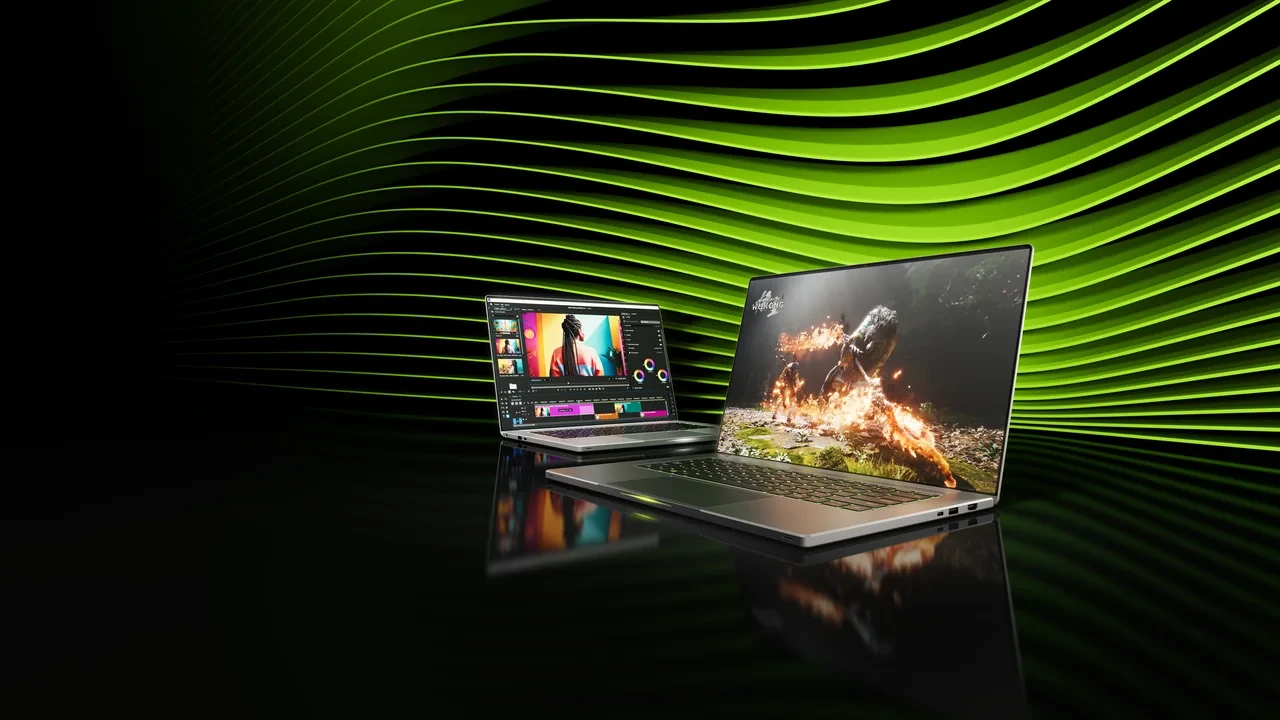
GeForce RTX 5050 Laptop GPU DLSS 5 benchmark
Public GeForce RTX 5050 Laptop GPU data opens at 21:00 Pacific Time on September 3, 2026. Before then, the only citable FPS figure is one native measurement: 24.7 FPS in Cyberpunk 2077 at 1920×1080 Ray Tracing Ultra with DLSS off. Development teams can use the time before launch to lock the rig and prepare a report that survives review.
The laptop belongs to the RTX 50 Series, but that family position doesn’t supply unmeasured game results. Record the verified boundary, build a reproducible test, and keep DLSS 5 figures out of launch documentation until the public driver and SDK can be tested.
Who Needs This Test
The test plan is for game developers, technical artists, performance engineers, and QA leads who need defensible laptop measurements and a clear record of what cannot yet be measured.
What the Evidence Covers
No DLSS 5 Cyberpunk result is estimated, and desktop RTX 5050 numbers aren’t transferred to the laptop. The platforms differ, and any figure outside the verified set would be invented.
The RTX 5050 Laptop in the RTX 50 Series
The RTX 50 Series is NVIDIA’s current GeForce generation, and within it the laptop stack is its own platform with its own power, thermal, and memory targets. The public series reference frames the generation as a Blackwell-based line that spans desktop, laptop, and professional SKUs, with DLSS 5 coverage tied to the RTX 50 family as a whole. Treat the laptop as a distinct platform: the same name does not imply the same board, the same TGP, or the same memory configuration as a desktop part.
A reproducible laptop GPU benchmark must report the chassis, TGP, and memory configuration beside the FPS value. The same model name can perform quite differently across two OEM chassis under sustained load, enough to separate a shippable target from a flood of player complaints.
A Laptop Result Is a System Result
A laptop GPU is sold to OEMs with a configurable power envelope rather than a fixed TDP. The OEM chooses a TGP range, cooling solution, chassis, and firmware policy. A benchmark reflects that complete system, not the silicon alone.
For a studio, that means a single GeForce RTX 5050 Laptop GPU result is rarely enough to anchor a performance budget. A representative chassis, a representative BIOS, and a representative power profile are needed before a number can be treated as canonical.
DLSS 5 Status Before Launch
DLSS 5 is the next generation of NVIDIA’s upscaling and frame-generation stack and is scheduled to launch as part of the RTX 50 Series platform. The official support status for the RTX 50 Series laptop family is that DLSS 5 is treated as an RTX 50 Series capability, with launch data gated until the stated release time. In practice, the SDK, the public driver, and the published feature matrix may not yet contain the configurations needed to label a game build as “DLSS 5 supported” on a shipping RTX 5050 Laptop.
Until the launch window opens, a developer report should describe DLSS 5 as scheduled to launch on the RTX 50 Series, name the platform correctly, and avoid claiming verified DLSS 5 frame rates on this specific GPU. That phrasing is the difference between a defensible technical note and a claim that cannot be backed up.
The Only Verified Public FPS Result
The only verified native FPS value in the public record is a single measurement from a third-party laptop GPU database. The measurement is for Cyberpunk 2077 at 1920×1080 with the Ray Tracing Ultra Preset and DLSS off, and it averages 24.7 FPS. The source is the Notebookcheck RTX 5050 Laptop benchmarks and specs page, which compiles laptop GPU results across chassis and test runs.
That number is useful, but it is narrow. It is a native, ray-traced workload at a single resolution with DLSS disabled. It shows what the GPU looks like at the high-cost end of the ray-tracing spectrum at 1080p. It does not show how the same GPU behaves in a non-ray-traced preset, at 1440p, with frame generation, with DLSS 5, or in a different title.
What 24.7 FPS Tells a Developer
A 24.7 FPS average at Ray Tracing Ultra shows the cost of this workload rather than the GPU’s value as a whole. Native 1080p at that preset is an extreme case normally addressed through upscaling, frame generation, or lower settings. The next test must show what those paths deliver after a 30 minute thermal soak.
Plan separate runs for native, native plus upscaling, and native plus upscaling plus frame generation. Each becomes citable only after its feature is public and the rig can reproduce it.
Boundaries of the 24.7 FPS Result
| Aspect | Included in the verified data point | Not included and not safe to quote |
|---|---|---|
| Title | Cyberpunk 2077 | Any other game |
| Resolution | 1920×1080 | 1440p, 1600p, 4K, ultrawide |
| Preset | Ray Tracing Ultra | RT Ultra Off, RT Medium, RT Low, custom |
| DLSS state | Off | DLSS Quality, Balanced, Performance, Ultra Performance |
| Frame generation | Not measured | On or off, any generation |
| DLSS 5 | Not measured, not yet public | Any DLSS 5 mode |
| Chassis | Not specified in the public number | Specific OEM SKU, TGP, cooling design |
| Session length | Not specified | Sustained 30 minute, 60 minute behaviour |
Every cell in the right column needs either an internal test or a citable public source. Leave it blank until one exists rather than forcing a launch report to carry an invented marketing claim.
Build a Reproducible Laptop Benchmark
Document the rig before running the scene. Hardware, software, power state, and test route all belong in the record; without them, the result is only an anecdote.
Hardware Capture
For the GPU, record the model name, the part number as reported by the driver, the configured TGP, the BIOS version, and the chassis SKU. For the CPU, record the model, the configured PL1 and PL2 values, and whether the test enforces a particular power profile. For memory, record the capacity, the speed, and the channel configuration, because GPU memory traffic can be sensitive to system memory bandwidth on some titles.
For storage, record the drive model and the available free space, and install the game on the same physical drive across runs. For the display, record the panel resolution, the refresh rate, and whether the test runs in fullscreen exclusive, borderless, or windowed mode. The display path can change frame pacing without changing the rendered frame cost.
Software Capture
Record the GPU driver version and the VBIOS version, the operating system build, the .NET runtime where relevant, the game build or patch version, and the values of any in-game graphics options. Record whether the build is a development build, a release candidate, or a shipping build, because shader compilation and asset streaming paths can differ between them.
Record whether any background services are running, whether overlays are disabled, and whether the OS power plan is set to a known profile. Cloud sync, RGB control software, and OEM performance utilities are common silent contributors to variance.
Power, Thermals, and Session Design
Set the laptop to the power profile the team intends to measure. For a launch benchmark, that usually means the OEM’s “Performance” or equivalent mode, with the laptop on AC power, on a flat surface, with the vents unobstructed. Let the chassis warm up with a five minute idle or a warm-up pass before the timed run, because the first minute of a cold chassis does not represent a sustained session.
For the timed run itself, capture at least a 60 second window from a stable point in the scene, then capture a second 60 second window to confirm that frame pacing is stable. A single 10 second burst hides thermal throttling and frame-time spikes that a real player will see.
Scene and Camera Control
Use a fixed camera path or a saved replay rather than a free-roam session, and lock the player input so the scene is identical across runs. The scene should include a representative mix of the rendering features the game actually uses: shadows, reflections, ambient occlusion, post-processing, and, if relevant, ray-traced effects. A scene that only taxes triangles or only taxes bandwidth will not predict shipping behaviour.
Where the engine exposes a deterministic playback or a benchmark mode, prefer that. Where it does not, save a replay file, validate the replay byte-for-byte across runs, and use a fixed camera transform to keep the workload steady.
Measure FPS, Frame Time, and CPU Cost
Average frame rate makes the headline, but it hides the worst one percent of frames that players actually feel. A run whose one percent lows fall to half the target will feel worse than another run with the same average and lows near the target. The chart may show a tie; the experience won’t.
Frame Time and Pacing
Frame time is the wall-clock interval between consecutive presented frames, measured in milliseconds. Plot it over a 60 second run and look for spikes, periodic dips, and long-tail behaviour. A clean run stays in a tight band around the target. A throttled run climbs as the chassis heats, then recovers suddenly when the thermal limit releases.
Frame pacing matters even when the average is good. Pacing spikes above the target frame time by 50 percent or more are visible as judder, and on a high-refresh laptop panel they are immediately obvious. Capture pacing in addition to the average so the QA report is honest about the player experience.
CPU Cost and the Frame Budget
At the lower frame-rate target, the budget is 16.67 ms; at the higher target, it is 8.33 ms. A 6 ms GPU pass still misses the target if the CPU takes 12 ms. Profile both processors and treat the slower one as the binding constraint. A faster GPU cannot fix a laptop CPU bottleneck.
For a launch benchmark on a new laptop GPU, treat the CPU as part of the result, not as background. If the same scene on a desktop with the same GPU shows a CPU-bound limit, the laptop number will not catch up by adding GPU power.
What DLSS 5 Changes for Development
DLSS 5 retains the previous generation’s basic structure: upscaling reconstructs a higher-resolution image, frame generation inserts presented frames, and the model can change over time. The RTX 50 Series is the platform scheduled to receive it, including this GPU. Platform support still doesn’t provide a verified result for a particular game.
Engine Integration Work
For an engine integration, the work pattern is familiar: enable the upscaling and frame-generation paths through the standard SDK, validate that the per-frame cost and the per-frame latency match the SDK’s published budget on the target GPU, and confirm that the output survives a save and reload, a window resize, and a display mode change. None of that changes because the version number changed.
DLSS versions can change the supported mode matrix, default quality presets, motion-vector handling, and validation tools. Use the SDK release notes to confirm driver support. A hand-written wrapper around the SDK also needs its own test pass.
Launch-Report Language
In a launch report, the safe statement is that DLSS 5 is scheduled to launch on the RTX 50 Series, that the GeForce RTX 5050 Laptop GPU is part of that series, and that any FPS number with DLSS 5 enabled is not citable until the launch window opens and a public source reports it. The unsafe statement is to quote a DLSS 5 frame rate on a specific laptop GPU today, because there is no verified public number to anchor it to.
The same caution applies to the integration side. Do not write “DLSS 5 supported” into a public build’s marketing copy, a Steam store description, or a patch notes page until the SDK, the driver, and the platform’s published feature matrix all agree that the title’s path is supported on the target GPU.
Launch-Day Test Plan
After the launch window opens, capture native, upscaled, and upscaled-plus-frame-generation results in a representative scene with the chassis locked to a known power profile. The report should give production, art, and QA enough rig detail to cite those numbers without reconstructing the test.
Scene Selection
Pick one scene that stresses the GPU: heavy lighting, heavy shadows, full-resolution reflections, and, if the game has ray tracing, a path that actually exercises the ray-traced effects. Pick a second scene that stresses the CPU: many agents, many physics bodies, a wide view, and a busy UI. A launch pass with only a GPU-bound scene hides the binding cost that determines the real player experience.
If the game supports a built-in benchmark mode, prefer that for the headline number and keep the custom scene for the internal report. The built-in mode is easier to reproduce across teams and across hardware refreshes.
Resolution and Quality Matrix
For the RTX 5050 Laptop, the realistic matrix is 1080p native, 1080p with upscaling quality, 1080p with upscaling performance, 1440p with upscaling quality, and 1440p with upscaling performance. Adding frame generation as a separate axis doubles the cell count, but it is worth the work because frame generation is the feature players will toggle on a laptop first.
Do not include 4K as a default cell. A 1080p panel is the most common RTX 5050 Laptop configuration, and 4K is a niche on this part. A 4K cell that nobody can reproduce is a number with no audience.
Publish the Headline, Keep the Full Matrix
Publish the headline native number, the headline upscaled number, and the headline frame-generation number for one or two canonical scenes. Keep the full per-resolution, per-quality, per-mode matrix internal, because the internal matrix is the one the team will use to set a recommended spec, and the headline number is the one the marketing copy will quote. The two should be derivable from each other.
If the headline number and the internal matrix disagree, the internal matrix wins for engineering decisions and the headline number is rewritten to match. Marketing and engineering should not be looking at different sets of facts.
Common Laptop Benchmark Failures
Most bad laptop results originate before the timed run. Chassis behavior, power profile, and driver state are the usual sources of variance.
Power Profile Drift
If the laptop is allowed to switch between a quiet profile and a performance profile during the test, the average frame rate will reflect a mix of two different operating points. Lock the profile, lock the AC state, and confirm with a tool that the GPU is reporting a stable power draw across the run. If the power draw drifts, the run is not a single data point.
Thermal Throttling During the Timed Run
A short timed window can end before the chassis reaches its thermal limit. Add a warm-up pass and compare the first 30 seconds of a longer run with the last 30 seconds. A large gap indicates thermal throttling in the chassis rather than a change in the GPU itself.
Driver or Build Drift Between Runs
If the driver, the game build, or the Windows build changes between two runs that are supposed to be comparable, the comparison is not valid. Lock the versions, and add a checksum or a build hash to the test log. Two runs that differ in build state can differ in frame time for reasons that have nothing to do with the GPU.
Display Path and Variable Refresh
Variable refresh rate changes the presented frame cadence without changing the rendered frame cadence, and that confuses every metric that assumes a fixed refresh. Decide in advance whether the test runs with VRR on or off, and document the choice. Do not average a VRR run and a fixed-refresh run into a single headline number.
Player-Facing DLSS 5 Language
Player-facing copy is where most of the damage from an over-eager launch report shows up. A patch note that says “DLSS 5 support added” on the day the SDK ships is fine; a Steam description that says “DLSS 5 supported” on the day the GPU launches but the SDK has not yet published a validated path is a support ticket waiting to happen.
Safe Phrasing During the Gated Window
During the launch-data gated window, the safe phrasing is that DLSS 5 is scheduled to launch on the RTX 50 Series, that the GPU is part of that series, and that DLSS 5 support will be confirmed once the SDK, the driver, and the game’s integration pass are all in place. That phrasing is honest, and it gives the team a clean handoff into the post-launch window.
Phrasing to Avoid
Avoid “DLSS 5 ready”, “DLSS 5 supported”, and any claim of a specific DLSS 5 frame rate on this specific GPU. Avoid transferring a desktop RTX 5050 number to the laptop variant, and avoid transferring a number from a neighbouring RTX 50 Series laptop SKU. Each GPU and each chassis is its own data point.
Internal Report Checklist
Do not circulate a launch report until every item below is recorded.
- Chassis SKU, TGP, BIOS, and driver version are recorded in the test log.
- Game build, scene, camera path, and graphics options are recorded with hashes where possible.
- Power profile, AC state, and thermal state at the start and end of the run are recorded.
- Frame rate, one percent lows, and frame time plot are captured for each mode.
- CPU and GPU binding cost are profiled separately and reported in the same document.
- Headline numbers are derivable from the internal matrix, and the two sets agree.
What the Public Source Provides
The verified number comes from a third-party laptop GPU database that compiles measurements across multiple chassis and test runs. Its GPU pages list native and synthetic results with enough rig detail to repeat a measurement on a comparable chassis. Before launch, that single native result is enough to begin an internal comparison without pretending the wider matrix is complete.
That single result defines the evidence limit: one configuration, with any later claim tied back to a measurement.
Platform-Level RTX 50 Context
Membership in the RTX 50 Series carries the family’s media engine, display path, driver line, and DLSS generation. It does not carry a desktop card’s power budget, another SKU’s TGP, or a workstation certification path. Early launch coverage often goes wrong by treating those separate facts as interchangeable.
The family also determines the upstream SDK version. Integrate the DLSS 5 SDK that targets the RTX 50 platform rather than an earlier SDK built for a previous generation.
Performance Budgeting for a Shipping Title
A performance budget is the agreed ceiling for frame time on a target configuration, and it is the contract between engineering, art, and design. The RTX 5050 Laptop sits in the budget as one of several target configurations, and the budget has to give the team room to ship on that part without forcing art to remove a feature the design depends on.
Choose the Canonical Scene
Measure the budget in a representative scene, not merely the most photogenic one. It should include the lighting model, shadows, post-processing pipeline, and asset density used through most of the game. A scene that taxes only one subsystem will miss the worst case players encounter.
Set a Reproducible Headline Number
The headline number is the average frame rate in the canonical scene, resolution, and quality preset. Because the team will quote it publicly, another tester must be able to reproduce it. If they cannot, it should not define the performance budget.
Set the One Percent Low Floor
The one percent low is the floor QA must defend, and it is stricter than the headline average. Set it from early measurements and do not relax it simply because the average remains on target.
After Launch: Measure Instead of Forecast
Once the gated data, SDK, and driver become public, the planned matrix can become a real measurement pass. Replace boundary statements with citable results only after the silicon has completed that pass.
Before then, retain the verified limits. An accurate boundary is more useful than a result that does not exist.
Frequently Asked Questions
Is the GeForce RTX 5050 Laptop GPU officially supported by DLSS 5?
DLSS 5 is scheduled to launch on the RTX 50 Series, and the GeForce RTX 5050 Laptop GPU is part of that series. The official support status is launch-data gated until the stated release time, so any claim of a verified DLSS 5 frame rate on this specific GPU is not citable today and should not be quoted in a launch report or in player-facing copy.
What is the only verified FPS number for this GPU right now?
The only verified FPS value on the public record is a 24.7 average in Cyberpunk 2077 at 1920×1080 with the Ray Tracing Ultra Preset and DLSS off. The source is a third-party laptop GPU database page for the RTX 5050 Laptop. Any other FPS number, including any DLSS 5 result, is not in the verified set and should not be quoted.
Can a desktop RTX 5050 result be transferred to the laptop variant?
No. The laptop and desktop parts are not the same platform: they differ in TGP, in chassis, in cooling, in memory configuration, and in the power profile the OEM is allowed to ship. A number from one is not a number from the other, and a report that transfers a desktop value to a laptop chassis is not reproducible.
Can a result from a neighbouring RTX 50 Series laptop SKU be transferred?
No, for the same reason. Each SKU has its own TGP, its own memory configuration, and its own chassis design, and each of those is part of the result. A neighbouring SKU is informative for a sanity check, not for a citable number, and a launch report should not present one as the other.
What should a developer test before the launch window opens?
Lock the test rig, including chassis, TGP, BIOS, driver, game build, scene, and power profile. Capture native frame rate, one percent lows, and frame time. Profile CPU and GPU binding cost separately. Do not yet quote a DLSS 5 result, and do not yet write DLSS 5 support into player-facing copy. The pre-launch phase is for rig validation, not for a headline number.
What should a developer test once the launch window opens?
Re-run the rig against the public driver and the public SDK, with the canonical scene and the canonical quality preset. Capture native, upscaled, and upscaled-plus-frame-generation modes. Compare the new numbers against the gated-window rig, confirm that the chassis behaviour is consistent, and only then circulate a citable headline number.
How should the team phrase DLSS 5 support during the gated window?
Use a phrase that names the platform and the launch window, such as “DLSS 5 is scheduled to launch on the RTX 50 Series”, and avoid any phrasing that claims a specific verified result on the specific GPU. Once the launch window opens, the phrasing can be tightened to a supported-path statement that the SDK, the driver, and the integration all agree on.
What is the difference between DLSS upscaling and DLSS frame generation in a benchmark?
Upscaling changes the rendered resolution while keeping the presented frame count the same, and the cost is paid in the GPU’s render path. Frame generation inserts additional presented frames between rendered frames, and the cost is paid in a combination of motion-vector work, optical-flow analysis, and the present path. A benchmark that only reports the average hides the difference, and a frame-time plot shows it clearly.
Why is the 24.7 FPS Cyberpunk 2077 number still useful even though it is native and ray-traced?
It anchors the high-cost end of the workload spectrum at 1080p on this GPU, which is the regime where a player is most likely to reach for an upscaling or a frame-generation toggle. It is also a boundary marker that makes every other claim in the report more honest, because it gives the team a single citable data point against which to compare future measurements.
What is the smallest reproducible test rig for a laptop GPU benchmark?
At minimum, lock the chassis, TGP, BIOS, driver, game build, fixed camera path, power profile, and AC state. Add a 60 second warm-up, a 60 second timed run, and a frame-time plot. Without that record, the result is an anecdote rather than a reproducible benchmark.
All Citable and Unmeasured Rows
| Configuration | What the data point covers | Source status | Safe to quote? |
|---|---|---|---|
| Cyberpunk 2077, 1920×1080, Ray Tracing Ultra, DLSS off | Single native measurement, 24.7 FPS average | Public, third-party laptop GPU database | Yes, with the rig caveat |
| Any other game, any other preset | Not measured in the public dataset | Not in the verified set | No |
| DLSS Quality / Balanced / Performance / Ultra Performance | Not measured | Not in the verified set | No |
| DLSS 5, any mode | Launch-data gated | Not in the verified set | No |
| Frame generation on or off | Not measured | Not in the verified set | No |
| 1440p, 1600p, 4K, ultrawide | Not measured | Not in the verified set | No |
| Desktop RTX 5050, any SKU | Different platform, not transferable | Outside the verified scope | No |
| Neighbouring RTX 50 Series laptop SKU | Different chassis, not transferable | Outside the verified scope | No |
Only the first result is citable today. Every other row requires a new test or a public source after launch.





Leave a Reply