
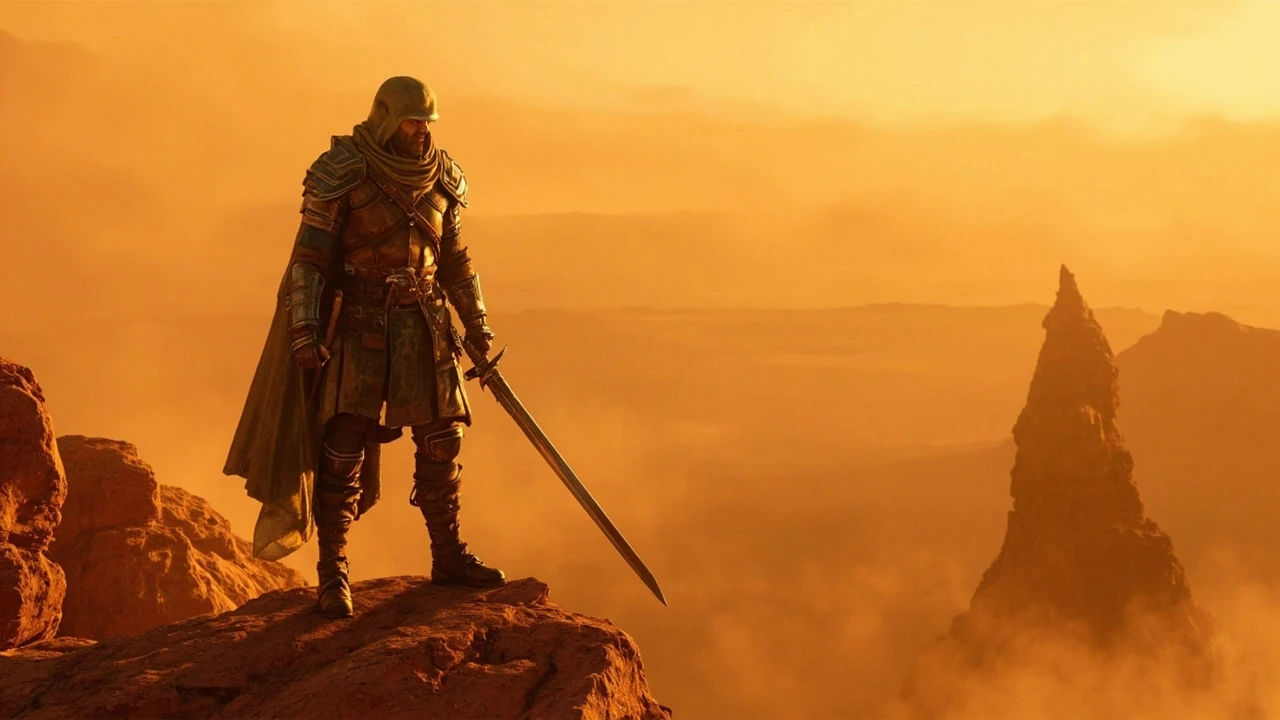
Bared fang crimson desert: what the weapon is and how it works
The Bared Fang is one of the named single-handed swords in Crimson Desert, Pearl Abyss’s open-world action game set on the continent of Pywel. Players who type “bared fang crimson desert” into a search box usually want the same three things: a clear description of the sword, a practical idea of how it performs in combat, and a realistic sense of whether it is worth the effort to obtain. This guide treats the Bared Fang as a combat-design object rather than a collectible, so the focus stays on its moveset, stat profile, and the play style it actually rewards.
Crimson Desert uses a stance-based melee system where each named weapon belongs to a category that governs its inputs, combos, and defensive options. Single-handed swords occupy a middle ground between faster short blades and heavier two-handed weapons, trading raw damage for reach, combo flexibility, and reliable guard options. The Bared Fang is a notable example of that middle ground because its description and asset design lean toward a duelist’s weapon rather than a crowd-clearing tool.
Before equipping it, you should know the build context in which the sword feels fair, the enemies and scenarios where it can feel underpowered, and the upgrade path that converts a stylistic pick into a long-term option. The rest of this article walks through those points in the order a typical player would encounter them.
Combat system context: why single-handed swords behave the way they do
Crimson Desert’s melee combat is built around a small set of weapon categories that share animation logic across a family of named weapons. Single-handed swords are a core category that almost every player will use at some point, because several early-game rewards and shop weapons fall into this group. The category’s design priorities shape how the Bared Fang performs:
- Balanced attack speed: fast enough to react between enemy wind-ups, slow enough that each hit carries meaningful stagger.
- Medium reach: longer than a dagger, shorter than a spear, which affects spacing against groups and single bosses.
- Full combo strings: usually three to five hits per string, with directional modifiers that open a small number of follow-up branches.
- Defensive tools: a usable block or parry window on most animations, and a dodge cancel available on the later hits in a string.
- Stamina cost: moderate per swing, with combo finishers costing more than jab inputs.
These properties are not unique to the Bared Fang. They are shared with other single-handed swords in the same tier, so the differences between named weapons come from stat modifiers, weight class, special effects, and any unique moveset branches. Reading the weapon’s stat card and performing a few test swings in a safe area is the fastest way to see whether those differences matter for your build.
Bared Fang weapon profile at a glance
The numbers below describe the Bared Fang as a mid-tier single-handed sword. They are intended to give a sense of its role rather than a precise stat sheet, because Pearl Abyss can adjust values through patches. Where a value depends on upgrade level, the table lists the expected band rather than a single figure.
| Attribute | Bared Fang (base to fully upgraded) | How it compares within the single-handed sword group |
|---|---|---|
| Weapon class | Single-handed sword | Same category as most early and mid-game one-handers |
| Primary damage type | Slash, with light thrust on the third input | Typical for the category; thrust inputs open certain stagger windows |
| Weight class | Medium | Heavier than light dueling swords, lighter than curved cleavers |
| Attack speed | Moderate, with a noticeable pause before the finisher | Slower than “quick” one-handers, faster than heavy hitters |
| Reach | Average for the category | No reach advantage over peer swords of the same tier |
| Stagger on hit | Reliable on standard attacks, strong on the finisher | Stronger stagger than light swords on the third and fourth hits |
| Guard and parry | Usable block, short parry window on the first attack of a string | Average block; parry window is shorter than specialist parry weapons |
| Dodge cancel | Available on hits two through five | Standard for the category |
| Stamina cost per swing | Low to moderate | Lower than heavy two-handers, comparable to peer one-handers |
| Special property | Modest bonus to follow-up damage after a successful parry or stagger | Not unique; similar conditional bonuses exist on other named swords |
| Recommended level band | Mid-game, roughly the player’s first major open-world region | Useful earlier if obtained early, still relevant after upgrades |
The short version is that the Bared Fang is a reliable mid-tier single-handed sword with a slight bias toward the parry-and-punish loop that the category already supports. It is not a top-tier weapon, and it is not a novelty pick. It sits in the comfortable middle of its group, which is exactly the position its description suggests.
How the Bared Fang behaves in real combat
Reading stat cards is useful, but combat in Crimson Desert is decided by spacing, stamina, and how the sword interacts with the game’s three main enemy patterns. The Bared Fang’s performance can be summarized in three scenarios that every player will face.
Against single human-sized enemies
Against bandits, soldiers, and other medium-size foes, the Bared Fang performs close to its stat card. A standard three-hit string lands consistently and gives a dodge cancel on the second and third hits, which is enough to reposition against a counterattack. The third input’s thrust opens a small stagger window that lets you chain into a follow-up without resetting the combo. The finisher has a longer animation and a higher stamina cost, so against quick enemies it is often smarter to cut the string short and reset to a defensive stance.
Against groups and mixed enemy sizes
Group fights are where a mid-tier one-handed sword either earns its slot or exposes its limits. The Bared Fang’s reach is average for the category, so it does not trivially out-space polearms or spears, but it is long enough to keep a dagger-wielding enemy just outside their ideal range. The biggest risk in group fights is being surrounded while locked into the finisher animation. Two habits help:
- Cancel into a dodge after hit two or three, instead of always committing to the finisher.
- Use the directional input to shift the next attack toward the enemy pressing hardest, rather than the one you started the string on.
Those two habits are not specific to the Bared Fang, but they are especially valuable on a weapon whose finisher leaves you stationary for a noticeable window.
Against larger monsters and bosses
Bosses and large open-world monsters expose a common weakness of mid-tier single-handed swords: their stagger is reliable on standard enemies but less impressive on creatures with high poise. The Bared Fang’s parry window is short, and a failed parry on a heavy attack is a punishing opening. Against this class of enemy, the safer pattern is:
- Wait for a committed attack with a clear recovery frame.
- Land one or two hits, not a full string, then back off.
- Use the thrust input after a successful stagger to extend the punish window.
- Save the finisher for when the boss is downed or stunned, not for neutral exchanges.
This is a more patient play style than the Bared Fang’s animation set suggests on paper. The sword rewards you for treating it as a tool that creates openings, not as a weapon that overwhelms the enemy with raw output.
How to obtain the Bared Fang
There are a few common ways named mid-tier swords enter a player’s inventory in Crimson Desert, and the Bared Fang is typically available through one of them rather than a single fixed quest. Treat the order below as a practical checklist rather than a guaranteed route, because patch notes and region-specific rewards can change the exact source.
Purchase from a regional weapons vendor
The most reliable way to obtain the Bared Fang early is from a smithy or traveling vendor in the same open-world region where the weapon’s recommended level band applies. Vendors restock on a regular cycle, and their inventory scales with the player’s progress, so if the sword is not visible the first time you visit, returning after a main story milestone or after enough time has passed in the in-game day usually brings it back into the rotation.
Loot from a mid-game side dungeon or bandit camp
Several mid-tier named weapons in Crimson Desert are tied to specific dungeons, camps, or miniboss encounters. The Bared Fang is one of the weapons that can drop from a miniboss in a side dungeon in the same region where it is sold. The drop is not guaranteed, so plan on a few clears if you are aiming for the drop rather than the purchase.
Reward from a faction or contract
Some named weapons are awarded as a fixed reward for completing a faction contract, a hunting board request, or a story chapter. Check the reward preview on any contract you accept, because a Bared Fang-class weapon will occasionally appear as a non-random reward and save you the trouble of farming a drop.
Crafted from gathered materials
If you prefer a self-sufficient path, the Bared Fang can usually be crafted at a smithy once you have the right combination of ore, monster parts, and a small currency cost. Crafting is a sensible option if the vendor’s stock is empty and the drop rate is not cooperating, but it does not bypass the material grind.
Upgrades, infusion, and how to scale the weapon
Obtaining the Bared Fang is only the start. Its real value depends on how you upgrade it, whether you apply a forging modifier, and how you slot it into your overall build. The points below cover the most common upgrade paths and their practical trade-offs.
Standard upgrade path
The standard upgrade path raises the base damage and, at certain thresholds, slightly improves stagger or reduces stamina cost. The first few upgrade levels give the largest relative gain, so it is usually better to push a mid-tier weapon to its second or third upgrade tier before comparing it against a higher-tier but un-upgraded sword. For the Bared Fang, the comfortable “feels finished” point is around the third upgrade tier, with diminishing returns after that.
Forging modifiers and stat biases
Crimson For additional context, Desert’s forging system lets you apply a modifier that biases the weapon’s damage toward a chosen stat, such as strength, agility, or a hybrid scaling. The Bared Fang’s scaling is usually biased toward a hybrid profile, so the practical question is whether your build already invests in that stat. If it does, the modifier turns a stylistic pick into a strong one. If it does not, the modifier is a small loss rather than a hard lock, and you can either respec or keep the weapon as a sidearm.
Socket and rune handling
Mid-tier swords typically have one or two sockets that accept runes or gems. For the Bared Fang, the highest-value socket options are usually:
- A flat damage rune, to keep the weapon competitive as you out-level the region.
- A stamina-on-hit rune, if you rely on the parry-and-punish loop and need the resource back.
- A conditional damage rune that activates after a parry or stagger, which amplifies the sword’s existing identity.
Socketing is a long-tail investment, so swap runes only when you have spare materials and a clear reason to change your combat loop.
Where the Bared Fang fits in a build
The Bared Fang is a strong fit for three common play styles and a poor fit for two. Knowing which side of that line you are on saves you the time of forcing a build that does not work.
| Build style | Fit with the Bared Fang | Why it works or does not |
|---|---|---|
| Parry-focused duelist | Strong fit | Short parry window and reliable follow-up damage reward patient play. |
| Stamina-heavy hybrid build using both sword and sidearm | Strong fit | Moderate stamina cost per swing leaves room for off-hand weapon skills. |
| Open-world exploration build that swaps weapons often | Good fit | Balanced stats make it a sensible default for unknown encounters. |
| Heavy two-handed powerhouse build | Poor fit | The two-handed class has higher per-hit damage and longer stagger windows. |
| Fast daggers-and-dodge build | Marginal fit | Light weapons land more hits and have a more forgiving dodge cancel. |
If your build already invests in a heavy two-handed weapon, the Bared Fang will not replace it as your main. It can still serve as a sidearm for encounters where mobility matters more than raw stagger. If you are on a hybrid or duelist path, it is a sensible main weapon that does not force a respec.
Common mistakes when using the Bared Fang
Most of the frustration players report with mid-tier single-handed swords in Crimson Desert comes from a small set of habits that the weapon does not reward. The list below describes the mistakes that show up most often, and the safer pattern that replaces each one.
- Committing to the full finisher on every string. The finisher is best reserved for staggered, downed, or cornered enemies, not for neutral exchanges.
- Attempting parries on heavy attacks without a clear read. The parry window is short, and a whiff on a heavy attack is one of the most punishing openings in the game.
- Equipping the Bared Fang as a main on a two-handed powerhouse build. The stat profile will feel weak, and you will end up blaming the weapon instead of the build mismatch.
- Ignoring the thrust input on the third hit. The thrust is the easiest way to extend a punish window against medium-size enemies, and skipping it leaves damage and stagger on the table.
- Over-upgrading a weapon you will replace. Pushing the Bared Fang past its comfortable tier is fine as a fun project, but the return on investment drops quickly if you plan to switch to a late-game weapon.
Correcting those habits usually produces a more noticeable improvement than a few extra upgrade levels, which is why combat guides for Crimson Desert tend to emphasize input choice over raw stat chasing.
How the Bared Fang compares to peer weapons in the same tier
Within the single-handed sword group, the Bared Fang competes most directly with two or three peer weapons in the same level band. A side-by-side comparison is more useful than an abstract stat table, because the differences are small and depend on which stat you weight the most.
| Comparison | Bared Fang | Typical peer one-handed sword | What changes in practice |
|---|---|---|---|
| Damage per hit | Average for the tier | Average to slightly higher | Peer weapons can out-damage the Bared Fang by a small margin. |
| Attack speed | Moderate | Moderate to fast | Peer weapons may feel snappier on light input chains. |
| Parry window | Short but usable | Varies, often slightly longer on dedicated parry weapons | Specialist parry swords are more forgiving in chaotic fights. |
| Reach | Average | Average | Reach is rarely the deciding factor within the same category. |
| Stamina efficiency | Low to moderate per swing | Low to moderate per swing | Differences are small; stamina management is more about input choice than weapon choice. |
| Stagger on finisher | Strong | Strong | Both rely on the finisher as the main stagger tool, so the rest of the string matters less. |
| Best reason to pick it | Familiar input set, low upgrade cost, balanced feel | Higher peak damage, longer parry, or unique property | Pick the Bared Fang if you want a safe default; pick a peer if you have a specific build goal. |
The Bared Fang’s honest pitch is that it does not stand out in any one category, but it does not punish you in any category either. For a player who is still learning the combat system, that balance is an advantage, because the weapon exposes your own habits instead of hiding them behind raw numbers.
Player decision framework: should you equip the Bared Fang
Whether the Bared Fang is worth a slot in your current loadout depends on a small set of practical questions. Use the list below as a quick decision aid before you commit resources to upgrading it.
- Are you in or near the recommended level band for the region where the Bared Fang is sold or dropped? If yes, the weapon will perform as designed.
- Does your current build invest in the stat the Bared Fang scales with, or can you respec without losing more than you gain? If yes, the weapon is a good fit.
- Do you already use a heavy two-handed weapon as your main? If yes, treat the Bared Fang as a sidearm for mobility fights rather than a replacement.
- Do you have the materials to push it to at least its second or third upgrade tier? If no, consider a vendor weapon you can afford to upgrade right now.
- Do you enjoy the parry-and-punish loop, or do you prefer to overwhelm enemies with raw damage? The Bared Fang rewards the first style and feels average in the second.
If three or more of those answers point toward the Bared Fang, equip it. If only one or two point that way, a peer weapon is probably a more honest choice. This is the same framework most combat-focused guides use, and it tends to produce fewer regret purchases than going by the weapon’s description alone.
Performance and technical considerations
Beyond combat performance, there are a few technical points worth knowing for PC and console players who care about stable frame pacing during heavy fights.
- Particle density: the Bared Fang’s slash trails are moderate. In a group fight with several slash-based weapons on screen, the GPU load can spike briefly, especially in 4K.
- Animation priority: the finisher animation has a longer lock-in than the rest of the string, which can briefly reduce your ability to react to off-screen enemies. Use this information to plan your positioning.
- Save and load behavior: Crimson Desert saves on milestone triggers, not after every fight, so quitting mid-combat with the Bared Fang does not lose progress in the usual sense, but it does not save mid-fight state either.
- Modder caution: any mod that alters single-handed sword frame data will change the timing of the Bared Fang’s parry window. If you use mods, validate the timing in a low-stakes fight before relying on it against a boss.
These points are not specific to the Bared Fang, but they matter more on a mid-tier weapon that you will use often, because small inconsistencies show up faster in a weapon you have equipped for hours.
Patch sensitivity and version notes
Crimson Desert is a live game, and balance changes can move named weapons up or down a tier. The description in this article reflects the weapon as a mid-tier single-handed sword with average reach, moderate speed, and a short parry window. If a future patch changes the Bared Fang’s stagger, parry timing, or scaling, the practical advice in this article may need to be adjusted. The reliable signals to watch for are:
- Patch notes that mention single-handed sword damage or stagger adjustments.
- Changes to the recommended level band on the weapon’s stat card.
- Vendor rotation changes that move the Bared Fang into a different region or shop tier.
- Community reports of a noticeable timing change in the parry window, which is the most likely candidate for a stealth nerf or buff.
Treat the Bared Fang as a stable mid-tier pick in the current version, and re-evaluate after any major patch that touches melee balance. For broader context on the game’s reception and design, the Crimson Desert Wikipedia entry summarizes the development history and the public launch window, and a critically reviewed take on the launch build covers how the combat system holds up in a real playthrough.
Frequently asked questions
Is the Bared Fang a good weapon in Crimson Desert?
The Bared Fang is a reliable mid-tier single-handed sword that performs as advertised: balanced damage, moderate speed, a usable but short parry window, and a strong finisher. It is a good weapon for a player who is still learning the combat system, because it exposes your habits without hiding them behind raw numbers. It is not the highest damage option in its category, and it is not a novelty pick, so its real value depends on whether you enjoy the parry-and-punish loop.
Where do I get the Bared Fang in Crimson Desert?
The most reliable way to obtain the Bared Fang is to buy it from a regional weapons vendor in the open-world region where the weapon’s recommended level band applies. It can also drop from a miniboss in a side dungeon in the same region, appear as a fixed reward for a faction contract, or be crafted at a smithy with the right materials. Because patch notes can change the exact source, treat those paths as a checklist rather than a guarantee.
What level should I be to use the Bared Fang?
The Bared Fang is a mid-game weapon, aimed at players who are in or near the first major open-world region of Crimson Desert. If you pick it up earlier, it will perform slightly above your other options. If you pick it up later, it will feel underpowered until you upgrade it or use it as a sidearm.
Is the Bared Fang better than other single-handed swords?
Within its tier, the Bared Fang is average to slightly above average. Peer one-handed swords can out-damage it by a small margin, and dedicated parry weapons have a more forgiving parry window. The honest reason to pick the Bared Fang is that it is a safe, balanced default, not that it dominates its category.
Should I upgrade the Bared Fang or replace it later?
Upgrade the Bared Fang to its second or third tier, which is the point where the returns start to level off, and consider replacing it once you reach a region where late-game single-handed swords start to appear in vendor rotations. There is no shame in keeping it as a sidearm if you like its input set, because the cost of carrying a familiar weapon is mostly a few inventory slots.
Does the Bared Fang work with a shield or off-hand weapon?
Yes. The Bared Fang pairs naturally with a shield for a defensive duelist build, and with a sidearm for a hybrid build that swaps between two weapons. Pairing it with a heavy two-handed weapon in the same loadout is usually a poor choice, because the stat profiles do not complement each other.
What is the best forging modifier for the Bared Fang?
The best modifier is the one that matches the stat your build already invests in, because the Bared Fang’s scaling is biased toward a hybrid profile. If you are unsure, a flat damage modifier is the safest default, since it does not lock you into a build direction.
Can the Bared Fang carry me through the whole game?
It can carry you through the mid-game comfortably, and with upgrades it remains useful into the early late-game. Once you reach regions where late-game named weapons appear, the Bared Fang becomes a sidearm rather than a main, because raw damage starts to matter more than input familiarity.
What is the difference between the Bared Fang and the Bared Fang +1 or +2?
The plus variants are upgraded versions of the same weapon, with higher base damage and slightly improved stagger or stamina efficiency at certain upgrade tiers. They are not separate weapons with new movesets, so the input set and play style are identical to the base Bared Fang. If you plan to invest in the weapon, push it through the plus tiers rather than carrying two versions in your inventory.
Is the Bared Fang worth crafting if I cannot find the drop?
It is worth crafting if the materials are reasonable and you plan to use the weapon as your main or as a long-term sidearm. It is not worth crafting if you are still in the early game and will replace it quickly, because the material cost is better spent on a weapon that will see more use in your current level band.





Leave a Reply