
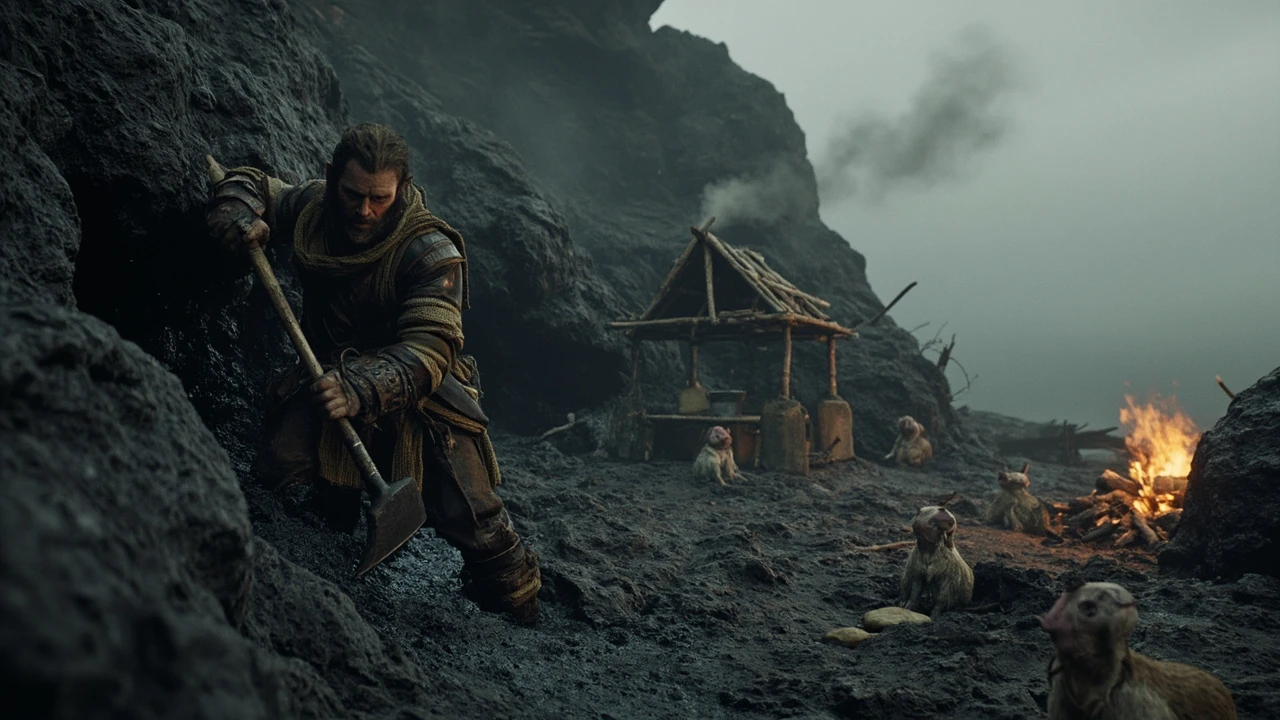
Coal in Palworld: where to find it and what to do with it
Coal is one of the first mid-tier resources a new player in Palworld runs out of. It looks unremarkable, but it quietly powers three of the most important early systems in the game: metal ingots, charcoal, and the basic generator that keeps a base lit and warm. Players who ignore coal end up stuck with wooden tools, low-tier weapons, and bases that shut down at night. Players who learn the resource properly can move from a cramped starter shack to a powered metal workshop within a few in-game days, and the difference is usually a single well-planned mining run rather than dozens of small ones.
What coal actually is in the crafting chain
Coal is a refined ore, not a raw stone. It sits between basic stone and higher-tier metals in the technology tree. Most players meet it for the first time when a tutorial objective asks them to craft a refined metal workbench, a furnace, or a generator. Each of those recipes wants coal as a fuel or a smelting ingredient, and the demand only grows as the base expands. By the time a base has two furnaces and a generator running, coal is consumed at a rate that surprises players who treated it as a curiosity during their first hour.
From a game design point of view, coal is a bridging resource. It is rarer than wood and stone but far more common than the refined metal ingots that depend on it. That rarity gap is intentional. It forces the player to balance short-term needs (lighting a furnace right now) against long-term plans (stockpiling enough for an ingot run) and to choose between spending labor to mine it or spending time to assign a Pal to do the same job. Understanding that balance is what separates a base that grows steadily from one that stalls every other in-game day.
Quick reference: coal at a glance
| Attribute | Value or behavior | Why it matters |
|---|---|---|
| Resource tier | Mid-tier refined ore | Used for smelting and as a fuel substitute for wood |
| Primary use | Crafting charcoal and refining metal ingots | Drives the metal production line |
| Secondary use | Fuel for the small generator and advanced furnace | Powers a base without constant refueling |
| Common gathering tool | Metal pickaxe or better | A stone pickaxe is slow and may not register the node |
| Best gathering Pals | Mining-type Pals with the Mining aptitude | Automate coal collection at a base or ranch |
| Found in | Rocky biomes, cliffside seams, and certain dungeon deposits | Biome choice affects the run time per trip |
| Stack size | Standard mid-tier stack, manageable in a chest | Easy to store near furnaces, no overflow pressure |
| Risk while gathering | Hostile Pals in mining biomes | Plan for combat or a fast escape path |
Where coal spawns in the world
Coal appears as dark, slightly glossy rock nodes scattered across several biomes. The seams tend to be larger and more clustered in rocky or mountainous regions, but smaller deposits also turn up in transitional zones between forests and cliffs. Players who only walk along roads and through starter plains will barely see any. The trick is to look for the color and the height. Coal reads as black on a wall of gray, and it is most often placed on vertical faces where stone crops out of the terrain.
Biomes that consistently produce coal
- Mountainous rocky biomes where dark stone outcrops interrupt lighter rock walls.
- Cliff edges and overhangs, where seams appear as black veins in gray stone.
- Caves and shallow mining tunnels, where coal often shares a room with stone and ordinary ore.
- Dry, sparse biomes with thin vegetation and visible bedrock, which tend to expose more mineral nodes per square meter.
Coal nodes are visually distinct from normal stone. They are darker, smoother, and slightly more reflective. In a screenshot they almost look wet. A useful habit when entering a new biome is to scan the upper third of the screen first, because many seams are placed on rock faces above eye level and are easy to walk past. Once a player has spotted two or three seams in a region, the rest of the area tends to follow the same pattern, and the rest of the run becomes a matter of choosing which seam to empty first.
Dungeon and event sources
Underground dungeons, mining ruins, and certain side dungeons have guaranteed coal deposits inside them. The spawn rate per room is higher than in the open world, and the rooms are usually compact, so a single run can fill several inventory stacks. Dungeons also reset on a timer in the official survival loop, which makes them a reliable farming location once the player is strong enough to survive them. A typical mining dungeon near a rocky biome yields enough coal to top up two furnaces and a generator for a full in-game day, which is usually enough to justify the round trip.
For players who prefer not to fight elite Pals, the safer option is to mark the dungeon entrance, clear the path, and return periodically. Bringing a Pal with a transport or carrying aptitude shortens the trip back to base, where the real value of coal is unlocked. Some players also chain two or three nearby dungeons into a single loop, which converts a long mining session into a steady pipeline.
How to gather coal efficiently
Coal is a tier-2 ore, and it behaves like one. The gathering speed and the drop rate per swing depend on the tool, the Pal assigned to the task, and whether the player is present or has set up a semi-automated route. Three things matter most: pickaxe tier, Pal aptitude, and the distance between the node and the nearest chest.
Picking the right tool
A metal pickaxe is the baseline tool. A stone pickaxe will eventually break coal nodes, but the per-swing damage is lower and the durability loss is higher, so the effective yield per minute is poor. As soon as the player unlocks refined metal ingots, upgrading the pickaxe to the next tier is the single biggest quality-of-life improvement for ore farming in general. A higher-tier pickaxe also tends to break several nodes per swing when used against a cluster, which is a small but consistent gain.
Tool durability is a hidden cost of mining. A long mining session can chew through a pickaxe, so the sensible habit is to carry a backup or to keep a crafting bench nearby. Repairing a tool at a workbench is cheaper than replacing it, and the materials for repair are usually the same ore the player is already mining. Players who skip repair and let a pickaxe break mid-run end up wasting time walking back to base, which is often the difference between a smooth session and a frustrating one.
Using Pals to do the work
Mining-type Pals with the Mining aptitude are the most efficient gatherers, because they swing faster than the player and can be assigned to a node and left alone. The base management system lets a player drop a Pal at a deposit, walk away, and come back to a full inventory. Some Pals are also better at carrying heavy ore back to a chest, which removes a large amount of the manual labor involved in a long run. A common early setup is one mining Pal on a coal seam and one transport Pal on a short route between the seam and a chest, both left running while the player explores or crafts elsewhere.
The two practical strategies are:
- Assign a mining Pal to a known coal seam near a base or a palbox so it can work unsupervised.
- Use a transport Pal with a high carrying capacity to move stacks of coal from remote nodes back to a central chest.
The first strategy works best when the base is built close to a coal-rich biome. The second is better for players whose base is in a safer location and who do not want to relocate just for one resource. A third option, used by players who run co-op sessions, is to keep one player on mining duty while the other focuses on crafting or base defense, which roughly doubles the effective yield per session without changing the base layout.
Comparing manual vs. Pal gathering
| Method | Yield per minute | Player attention needed | Best use case |
|---|---|---|---|
| Manual mining with a metal pickaxe | Moderate, depends on swing speed and node size | High, must be present | First trip to a new biome or a quick top-up |
| Assigned mining Pal at a static node | Steady, lower per swing but constant | Very low, can be left overnight | Base production line, long-term stockpile |
| Pal + player combo run | Highest in short bursts | Medium, must escort or clear enemies | Dungeons, dangerous biomes, timed farming |
| Ranch-style enclosed node | Low per node but fully passive | Almost none after setup | Supplemental supply while the player does other tasks |
The table is a guide, not a fixed benchmark. The actual numbers shift with player level, Pal quality, and tool tier, but the order of magnitude holds across patches. A dedicated mining Pal at a known seam will out-produce any manual method within an hour, and a Pal-plus-player run is the fastest way to empty a dungeon before it resets. The ranch option looks slow on paper, but it runs in the background, which is its real advantage: a base with one enclosed coal node produces coal while the player is asleep, exploring, or doing something unrelated to mining.
What coal is used for
Coal has three meaningful roles in the early game. Understanding all three prevents the player from spending the resource in the wrong order and ending up with a half-built base and no fuel. The uses are tied together, because the same chest of coal that fuels a furnace in the morning can power a generator in the evening, and the order in which the player spends it changes how the base feels at night.
1. Smelting metal ingots
Refined metal ingots are the single biggest sink for coal. A furnace needs a fuel source to heat ore into ingots, and coal is the cleanest fuel the player unlocks at this stage of the tech tree. Wood works, but it burns out quickly and forces constant refueling. Coal gives a longer burn per unit and frees the player from hovering over the furnace. Two furnaces running on coal and producing ingots at a steady rate will out-produce four furnaces running on wood with the same amount of attention, which is why most mid-game bases standardize on coal for smelting.
The standard recipe path is ore plus coal in the furnace, producing ingots. Ingots then feed the workbench for tools, weapons, and metal building pieces. A player who underestimates coal will be limited not by the number of furnaces but by the number of ingots those furnaces can produce per day. The bottleneck is almost always fuel, not ore, and a single extra chest of coal can change the entire pace of a base upgrade.
2. Crafting charcoal
Charcoal is a refined fuel used in advanced recipes and in some cooking stations. It is made by further processing coal in a furnace, which is one of the small but important resource loops the game uses to keep the player engaged. Charcoal is also a trade good, so surplus production has a value beyond personal use. The conversion from coal to charcoal is not free, and the furnace time required for the extra step is real, but the result is a denser, longer-burning fuel that fits better in a generator fuel slot and lasts longer in advanced recipes.
For more experienced players returning after a patch, the same logic still applies. The exact recipe numbers may shift, but the role of coal as the workhorse fuel of the early-to-mid base is unlikely to change, because it sits at the structural layer of the crafting tree. Understanding that layer is more durable than memorizing a specific number, and it is what makes a base feel smooth to run instead of constantly fighting the player for attention. The same pattern shows up in the wider design of Palworld as a survival-crafting title, where bridging resources tend to define the pace of the early game and the structure of the base that follows.
For a base that already has steady coal income, running a second furnace in parallel on charcoal production is a common mid-game move. The setup looks redundant, but it converts an awkward surplus into a compact, high-value fuel that can be stored in smaller numbers and traded more easily. Players who skip charcoal altogether tend to keep burning raw coal directly, which is fine early on but caps the base once generator uptime starts to matter.
3. Powering the small generator
The small generator is the first stable power source the player can build, and coal is one of its approved fuels. A powered base unlocks a chain of quality-of-life upgrades, including lights, refrigeration, and conveyor belts. A base without power forces the player back to manual feeding, manual crafting, and dark nights, which is workable in a solo session but becomes painful in a long playthrough. The transition from a manual base to a powered base is the moment when the game shifts from survival tactics to base-building strategy, and coal is the fuel that pays for that shift.
The trade-off is that a generator drains coal in the background. A player who runs a generator for several in-game days without refilling its fuel chest will wake up to a dead base. The fix is mechanical rather than clever: dedicate one coal chest to the generator, and either refill it manually at the start of each session or assign a Pal with a transport aptitude to keep it topped up.
Base layout for a coal-friendly production line
A good base is laid out around the resources it uses most. Coal is heavy, common, and consumed in bulk, so the design should put coal chests, furnaces, and generators close to each other and to the Pal work area. A base that scatters these buildings across the map ends up with a long walking distance between resource and product, and that distance quietly costs the player more time than any single upgrade.
A reliable base flow
- Place a coal chest near the entrance or the Palbox, so a mining Pal can deposit directly into the storage.
- Build at least two furnaces in a row, with a second chest for ingots on the output side.
- Keep a small generator on a separate power line, fed by its own coal chest, so a smelt-heavy session does not starve the base of electricity.
- Add a workbench in the same building block, so the player can convert ingots into tools and parts without running across the map.
This layout shortens the path between resource, fuel, and product, which means fewer trips and faster iteration. It also concentrates the heat sources in one safe room, which makes it easier to defend against raids and easier to repair after a fire. The exact footprint of the room does not matter as much as the principle: keep coal, furnaces, generators, and workbenches in one walkable block, and the base will feel responsive even at low levels.
How many coal chests do you need
One large coal chest is usually enough for a small base, but the answer depends on how many furnaces are running at once. A good rule is one full chest of coal per furnace per in-game day, plus a safety buffer for the generator. Running out of coal mid-smelt is the most common reason an ingot run stalls, and the fix is almost always more storage, not more mining. Two furnaces and a generator typically want three chests in circulation: one input chest for raw coal, one output chest for ingots, and one fuel chest dedicated to the generator. Splitting the storage this way also makes it obvious which resource is running low.
Coal vs. alternative fuels: when to switch
Coal is not the only fuel in the game, and it is not always the best one. Wood is free, abundant, and burns, but it is inefficient. Higher-tier fuels exist later in the tech tree and burn longer, but they require infrastructure the player may not have unlocked yet. The right choice depends on the stage of the playthrough and the size of the base. The decision is less about which fuel is “best” in the abstract and more about which fuel the base can reliably produce at the current scale.
Comparison of common fuel sources
| Fuel | Cost to obtain | Burn efficiency | Best moment to use it |
|---|---|---|---|
| Wood | Very low, gathered anywhere | Low, needs constant refueling | First furnace before the player has coal |
| Coal | Moderate, requires a mining run | Good, stable burn | Standard early-to-mid base production |
| Charcoal (refined from coal) | Moderate, requires a furnace | Better than raw coal per unit, more compact | Advanced recipes and trade goods |
| High-tier refined fuel | High, requires a developed base | Highest, very long burn | Late-game mega bases and automation lines |
The pattern is the same as in most survival-crafting games. Wood is the early bridge, coal is the workhorse, refined fuels are the late-game upgrade. Switching too early wastes effort, because the base has not yet built up the production chain that makes the more efficient fuel worth crafting. Switching too late caps the base size, because a base that runs out of fuel every in-game day has hit the upper limit of what coal alone can support. The honest answer to “when should I switch” is “when coal stops keeping up,” and the honest answer to “how do I know” is “when the generator dies in the middle of the night for the third time in a row.”
Common mistakes when managing coal
Most coal problems are not about finding the resource. They come from how the player spends it. The same coal that powers a base through a smooth week can be wasted in an evening by spending it on the wrong recipe, in the wrong order, at the wrong moment.
Using coal as a one-to-one wood replacement too early
New players often burn their first coal stockpile in a furnace that could have run on wood, then run out of coal the moment they need ingots. The fix is to keep wood around as the default fuel until the base is producing more coal than it consumes. A useful habit is to keep at least one stack of coal reserved in a personal chest for ingot recipes, and to spend raw coal on the generator only when the reserved stack is full.
Building the base far from coal biomes
A cozy starter base in a forest is fine until the player needs fifty coal for a metal ingot run. Relocating is painful, and the alternative is a long commute that wastes time every in-game day. When the base is being upgraded, it is worth moving the main structure closer to a rocky biome, or at least adding a satellite chest near a known coal seam. The satellite chest is the cheaper option when relocation is not realistic, because it converts the long commute into a single supply run that the player can batch with other trips in the same biome.
Ignoring Pal aptitude
Not all Pals mine at the same speed. A player who assigns a combat Pal to a mining node because it has the right type but a low aptitude will get less coal per hour than expected. Checking the Pal’s Mining aptitude before assigning it, and rotating in a better-suited Pal when one is captured, makes a measurable difference over a long session. The same applies to transport aptitude: a Pal with a high carrying capacity cuts several minutes off every supply run, which compounds over a week of play.
Forgetting the generator fuel slot
The small generator quietly drains coal, and a player who leaves the base running overnight often wakes up to a dead base. The fix is a dedicated fuel chest, an assigned Pal that refills it, or a scheduled downtime for the generator when the player is offline. None of these fixes are expensive, and any one of them prevents the most common coal-related frustration in the mid-game.
Designing a sustainable coal pipeline
Once the base is producing more coal than it consumes, the next step is to make the supply resilient. A single seam, a single Pal, and a single chest will all fail eventually. Redundancy is the difference between a base that survives a long session and one that stalls every other day. The aim is to make coal supply boring, in the sense that the player stops thinking about it, because the chests are always full and the furnaces never run dry.
Building redundancy into the supply
- Mark at least two coal-rich locations on the map, so a biome event or a hostile camp does not cut off the supply.
- Keep one backup mining Pal in a nearby palbox, so the main Pal can be rotated out for rest or healing without stopping production.
- Place a second coal chest near the smelting area, so the player is not bottlenecked by storage while the furnaces are running.
- Reserve a small coal buffer in a personal chest, so a sudden need for ingots does not require an emergency mining run.
Each of these moves is small on its own. Together, they convert a fragile supply into a stable one. A base that has all four in place can survive a missed session, a hostile migration, or a poorly chosen base location, because the supply has more than one weak point that needs to fail at the same time.
When to upgrade from coal to refined fuel
The signal that it is time to switch is when coal production cannot keep up with consumption. A base that runs out of fuel every in-game day, even with two mining Pals and a full chest, has outgrown raw coal. At that point, investing in the next fuel tier pays for itself in saved time. The exact threshold varies by base, but a useful rule is: if the player is spending more than one short mining run per in-game day just to keep the fuel chests full, the base is ready for refined fuel.
Coal in the broader crafting economy
Coal is a useful case study in how the game’s crafting loops are layered. Each tier of the tech tree introduces a resource that looks small on its own but powers several others. Stone powers wood cutters, wood powers basic buildings, coal powers ingots and generators, and ingots power the next tier of tools and machines. Missing one link in that chain stalls the whole line. The layered design is also why coal keeps showing up in unexpected recipes: each new tier of the tech tree tends to add at least one more use for an existing resource, rather than introducing a wholly new fuel for every machine.
For new players, the practical takeaway is to treat coal as a strategic resource from the first moment it appears in the inventory, not as a generic pickup to be burned on the first recipe that asks for it. The base will need it for a long time, and the time spent setting up a proper pipeline is paid back many times over the course of a playthrough. Players who do this from the start usually reach the metal tier of the tech tree with a comfortable reserve, while players who spend coal freely tend to spend the next several in-game days catching up.
Frequently asked questions
Where is the easiest place to find coal in Palworld?
Rocky mountainous biomes and the cliff faces around them are the most consistent source. Look for dark, slightly glossy seams that contrast with the surrounding gray stone. Coal also appears inside mining dungeons, where the spawn density per room is high and the nodes are close together.
Do I need a metal pickaxe to mine coal?
A metal pickaxe or better is strongly recommended. A stone pickaxe will eventually break coal nodes, but it is slower, costs more durability, and yields less per swing. As soon as refined metal ingots are available, upgrading the pickaxe is the cheapest way to speed up coal farming.
Which Pals are best for gathering coal?
Pals with the Mining aptitude are the most efficient. Within that group, the highest-tier mining Pals produce the most coal per minute, and Pals with a transport or carrying aptitude help move heavy stacks back to a chest. Pairing one mining Pal with one transport Pal is a common early-game setup.
Can I use wood instead of coal in the furnace?
Yes, wood can fuel a furnace, and it is a useful early substitute. The trade-off is efficiency. Wood burns out faster, so a furnace running on wood needs more frequent refueling. Coal and charcoal are denser fuels, and they are the better choice once the base is producing metal ingots at scale.
How much coal do I need for a small base?
A useful working estimate is one full coal chest per furnace per in-game day, plus a smaller reserve for the generator. Two furnaces and one generator usually need three to four chests of coal in circulation. The exact amount depends on the smelt cycle and the generator uptime, so it is worth tracking the first few runs to set a personal baseline.
Is it worth building a base near a coal seam?
For a focused early-to-mid base, yes. A base within a short walk of a coal-rich biome saves travel time and lets a Pal work the seam without supervision. The trade-off is safety and resources. A mountain base is often more exposed to hostile Pals and may be short on wood and food, so the decision is a balance, not an obvious win.
Does coal respawn in the same spot?
Yes, coal nodes respawn on a timer once they are depleted. The exact interval can vary by biome and by the type of node, but planning a route around respawn timers is more efficient than searching for new seams. Marking several known nodes on the map is the simplest way to keep a steady supply.
What should I do with surplus coal?
The two best uses for surplus coal are converting it into charcoal for advanced recipes and trading it at a merchant if the merchant rates are favorable. Storing it in a dedicated chest is also fine, because a stockpile is a hedge against a future patch that changes a recipe or a smelt cycle.
Can I automate coal production completely?
Partially, yes. A mining Pal assigned to a node and a transport Pal moving the output to a chest form a simple automated loop. Fully replacing the player usually requires a base layout with a palbox, a chest, and a Pal ranch or pen in the same area, which is achievable in the mid-game but takes planning.
What is the most common coal-related mistake for new players?
Burning the first coal stockpile in a furnace that could have run on wood, then running out of coal the moment an ingot recipe asks for it. The fix is to keep wood as the default fuel early on and treat coal as a strategic resource reserved for the recipes that actually need it.





Leave a Reply